.svg)


About six months ago, after much resistance, I started wearing a Whoop. It is a fitness wearable…other people might use something like an Apple Watch or an Oura Ring.
I’ve genuinely enjoyed the insights. Sometimes it reminds me I didn't move enough during my day. Other times it surfaces a trend that I end up feeling a few days later.
The other night, however, it was flat-out wrong.
I woke up to a "green" recovery score, meaning the data said I'd had a great night of sleep. High HRV, low respiratory rate, blah blah blah. Basically, all the right numbers were right.
The problem? I knew I didn't sleep well. I tossed and turned all night. The Whoop was wrong.
That moment reminded me of Jeff Bezos line that has stuck with me:
“When the anecdotes and the data disagree, the anecdotes are usually right. There is something wrong with the way that you are measuring it.”
That’s a provocative idea in a world obsessed with measurement. But it’s also deeply practical.
Because behind every data point is a human experience. And when we ignore that experience, we don’t become more objective, we become more disconnected.
Data is only as good as the questions we ask.
If you measure customer satisfaction with a single score, you might miss an underlying frustration.
If you only track employee engagement through surveys, you might overlook what’s really happening in the hallway conversations.
If you singularly optimize for efficiency, you might accidentally destroy loyalty.
The issue isn’t that data is misleading, it’s that it’s incomplete.
Metrics can tell you what is happening.
Anecdotes often tell you why.
And if you don’t understand the why, you’re just guessing with better spreadsheets.
There’s an old truth worth revisiting:
A person with experience is never at the mercy of someone with an opinion.
I’d add a modern layer to that.
A person with experience shouldn’t be overruled by someone with a perfectly formatted dashboard either.
Because firsthand experience carries context. Emotion. Nuance. It captures what can’t always be quantified.
A frontline employee who says, “Customers are getting frustrated,” is offering something no metric fully captures.
A leader who says, “This doesn’t feel right,” may be picking up on signals the system hasn’t learned to detect yet.
That’s not anti data. That’s pro reality.
The best organizations don’t choose between data and anecdotes. They interrogate the gap between them.
When the numbers say one thing but people are experiencing another, that’s not a nuisance. It’s a signal.
It’s an invitation to ask better questions. Are we measuring the right outcome? Are we missing a variable? Are we simplifying something that is inherently complex?
Too often, organizations double down on the data because it feels safer. Cleaner. More defensible.
But the real work, the meaningful work, is in sitting with the tension long enough to uncover what’s actually true.
Even in the most data rich environments in the world, context still matters.
Human behavior is messy. It’s dynamic. It doesn’t always fit neatly into categories or models.
And that’s exactly why anecdotes matter.
They restore the story behind the statistic.
They remind us that we’re not just managing systems, we’re serving people.
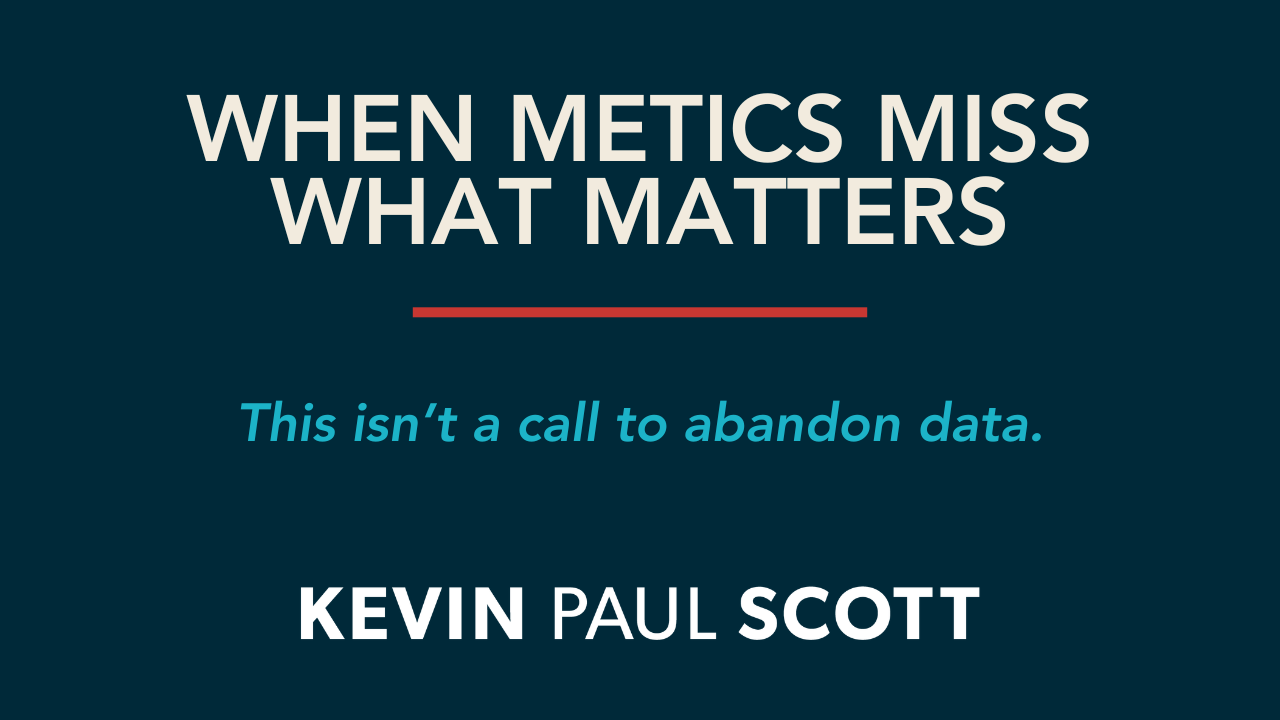
This isn’t a call to abandon data. It’s a call to elevate experience alongside it.